Where we come from, and where we stand.
A journey of leases and approvals, drilling and partnerships, in a district that has been producing gold for more than a century and a half.
Foundations
The ground remembers.
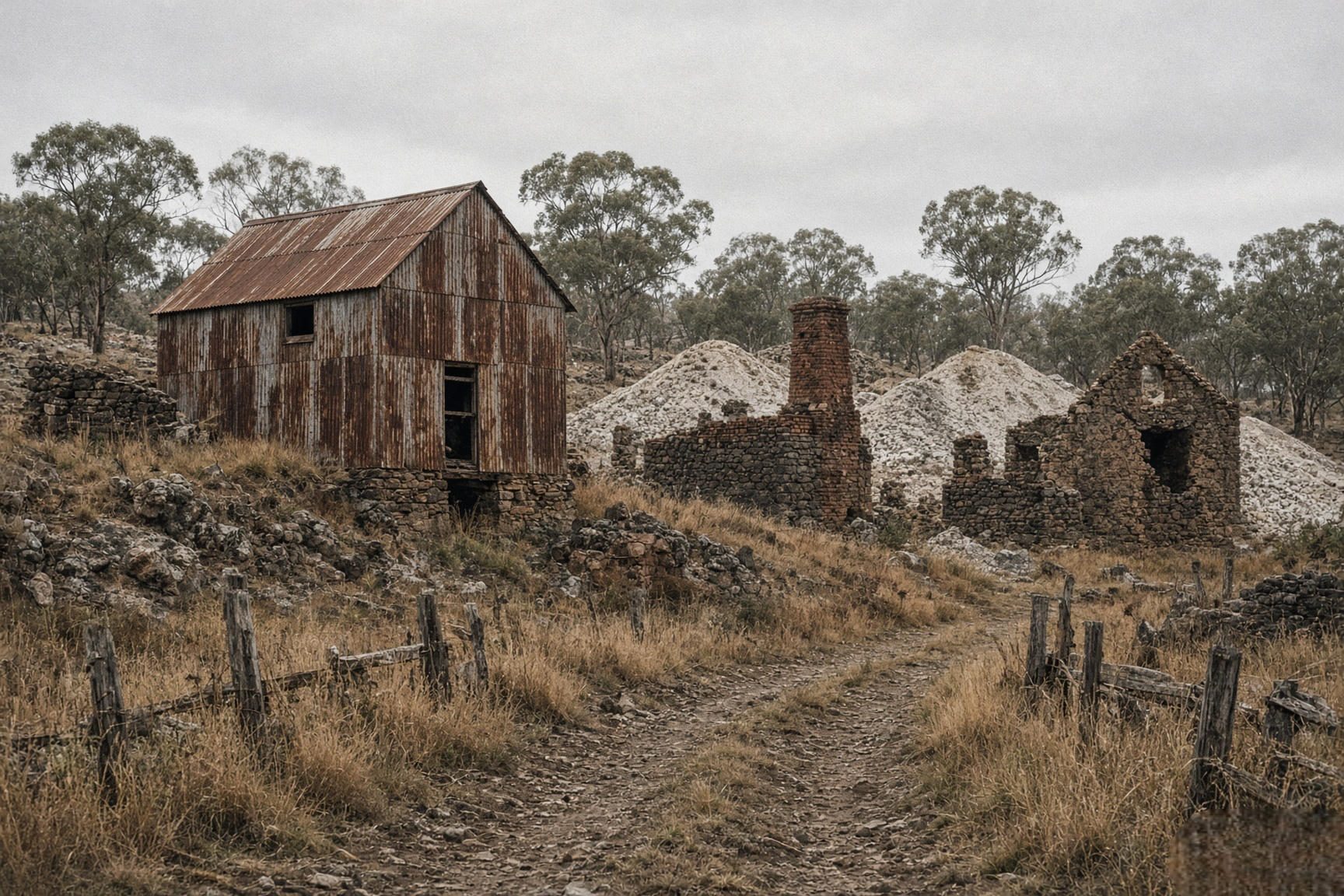
Long before there was a company, there was a goldfield. The country around Bendigo, Heathcote, Rushworth and Costerfield drew people from across the world in the rushes of the 1850s, and it has never entirely stopped producing.
Costerfield, just south of our ground, has yielded gold and antimony since the 1860s and remains one of the world’s premier producers of the two metals together. The old workings scattered through the district are a record of what the rock here holds — and, just as usefully, of what earlier generations could not reach with the tools they had.
Fosterville, to the west, was for many years treated as a modest oxide operation. In the mid-1990s, drilling beneath it found high-grade sulphides, and the district’s understanding of itself changed permanently. Fosterville went on to become the highest-grade and lowest-cost gold mine in the world at its peak.
Several of the people who worked on that discovery now work on ours. Our geology leadership carried out the original exploration across the Golden Camel deposits while working in the district, and our process manager has previously treated Golden Camel ore. The institutional memory of this ground did not have to be bought in — it is in the company.
Golden Camel Mining was formed in 2014 to consolidate that knowledge and the leases it pointed to. What follows is the record of what has been done since.
The record
A decade of quiet, cumulative work.
Each year added a lease, an approval, a drill result or a partner. None of it was dramatic. All of it was necessary.
2014
The company and its first ground
Golden Camel Mining is formed and acquires four leases in Central Victoria — two mining licences and two exploration licences — assembling the foundation of the present project.
2016
Permission to mine
The permit to mine is approved: the critical step that separates a prospect from a project, and the beginning of GCM's permitting record in a state where such approvals have become rare.
2017
Opperman and Shiraz
Two further exploration licences are granted, covering the Opperman and Shiraz deposits and extending the company's ground across the belt. Shiraz would prove to be the antimony-bearing trend.
2018
Gold poured, and the first look at depth
Trial mining and gold production begin, with ore treated at a nearby facility. The ore body is confirmed in practice rather than on paper. Deep drilling is initiated and the first deep sulphide intercept is drilled beneath the Golden Camel Mine. GCM enters an Earn-In and Option Agreement with Catalyst Metals Limited (ASX: CYL).
2019
Testing the depth story
Catalyst Metals carries out extension and preliminary deep drilling beneath the Golden Camel Mine, following the sulphide horizon that runs under the oxide ore.
2020
A processing partner
GCM signs a Strategic Partnership Agreement with Nagambie Resources Limited (ASX: NAG) to develop a Carbon-in-Leach processing facility on Nagambie's mining tenure — the decision that turned a group of deposits into a single integrated operation. Catalyst follows up with further diamond core holes, and GCM applies for two additional exploration licences.
2021
The hub becomes real
A Planning Permit is granted by the Strathbogie Shire covering vegetation removal and the construction, operation, tailings disposal and rehabilitation of the toll treatment plant. GCM and Nagambie Resources formalise the Nagambie Joint Venture to construct and operate the facility. A Carbon-in-Leach plant is purchased and delivered to site. Catalyst Metals earns a majority interest in two of the exploration licences, progressing an exploration joint venture.
2025
Steel on the ground
Major plant componentry, including the mill and items for the Carbon-in-Leach circuit, is delivered to the Nagambie site — procured and paid for rather than budgeted.
2026
Construction-ready
The process plant pad and tube cell pad are levelled and prepared. Mining licences and operating permits for the first mine and the processing plant are granted and in place. The project stands at the point where construction, rather than approval or exploration, is the next step.
We are here
Where we stand
The hard part is behind us.
Most mining stories are told from the front, in the language of discovery. Ours is told from the back. The ore body is confirmed, the licences are granted, the plant is approved, and its principal components are sitting on the site where they will be installed.
What GCM has accumulated over a decade is not a set of possibilities but a set of permissions — and in Victoria, permissions have become the genuinely scarce commodity.
From here the sequence is straightforward: build the first plant, mine the first oxide pit, and let the operation fund the mines and the second plant that follow it.

Next
The people who carried it this far.
Our board and managers have permitted, built and operated mines across Australia, Asia, Africa and the Americas.